
In converter steelmaking, the durability of tapping bricks is crucial for improving production efficiency and reducing costs. While traditional magnesia-carbon tapping bricks exhibit excellent slag resistance and thermal shock stability, decarburization under high-temperature and highly oxidizing environments remains a major factor limiting their service life. This paper proposes a low-carbon composite converter tapping brick, significantly improving its oxidation resistance and thermal shock resistance through optimized material formulation and preparation process. The novel tapping brick employs a radially layered design, with the carbon content (w) of the outer high-carbon layer and the inner low-carbon layer adjusted to 10%–20% and 3%–6%, respectively, to withstand thermal stress and chemical erosion at high temperatures. Experimental results demonstrate that the composite brick exhibits significantly improved stability and durability at high temperatures, effectively extending its service life. This material not only reduces maintenance costs and downtime in the steelmaking process but also possesses broad application prospects and market potential.
In the modern steel industry, converter steelmaking technology is a crucial step in producing high-quality steel. As an important component of the converter, the performance of the tapping brick directly affects the efficiency and cost of steelmaking. Traditional high-carbon magnesia-carbon bricks are widely used in converter lining due to their excellent slag resistance and thermal shock stability; however, decarburization problems in high-temperature and highly oxidizing environments limit their service life. With the development of steelmaking processes and increasing environmental protection requirements, developing a more durable, low-carbon, and environmentally friendly tapping brick has become an urgent need for the industry. In recent years, significant progress has been made in refractory material research both domestically and internationally. Some researchers have improved the oxidation resistance of magnesia-carbon bricks by adding antioxidants such as boron nitride and boron carbide. Furthermore, the introduction of nanomaterials is also considered an effective way to improve the performance of refractory materials.
This paper aims to develop a low-carbon composite tapping brick by optimizing the material formulation and preparation process to improve its oxidation resistance and thermal shock resistance, thereby extending its service life. Through systematic experimental research and performance testing, the superiority of the new low-carbon composite tapping brick was verified, and its potential in practical applications was explored. This provides new ideas for improving the production efficiency and environmental protection requirements of the steel industry, and also opens up new application prospects in the field of refractory materials.
1.Preparation and physicochemical properties of low-carbon composite steel tapping bricks
1.1 Composition of main raw materials
To prepare high-performance low-carbon composite taphole bricks, selecting suitable raw materials is crucial. High-purity 99% macrocrystalline fused magnesia (mass fractions: MgO ≥ 98.5%, Fe₂O₃ ≤ 0.2%, SiO₂ ≤ 0.2%, CaO ≤ 0.4%) was selected as the main raw material, with particle sizes ranging from 2–1 mm, 1–0.5 mm, 0.5–1 mm, to ≤0.088 mm. Macrocrystalline magnesia maintains stable structure and properties at high temperatures. Furthermore, flake graphite (fixed carbon mass fraction ≥ 98%) was used as the main carbon source, with a particle size ≤0.088 mm. Its high thermal conductivity and low coefficient of thermal expansion contribute to improving the material’s thermal shock resistance. Other matrix components were supplemented with composite carbon sources such as boron nitride powder [w(BN) ≥ 99%, particle size ≤ 1 μm], calcium boride, carbon black, high-temperature pitch powder, and boron carbide to enhance oxidation resistance. Aluminum powder, w(Al) ≥ 99%, particle size ≤ 0.044 mm; silicon powder, w(Si) ≥ 98%, particle size ≤ 0.088 mm; binder is thermosetting phenolic resin, with residual carbon content (w) ≥ 45%, viscosity 10–20 Pa·s, free phenol content (w) < 10%, and moisture content (w) ≤ 3%.
1.2 Preparation of Low-Carbon Composite Steel Tape Bricks
The preparation process of low-carbon composite steel taphole bricks includes the following steps:
(1) Raw material mixing: First, weigh 99 large-crystal fused magnesia particles of different sizes, and then mix them in a V-type mixer for 10 min to ensure the uniformity of the particles of different sizes.
(2) Additive premixing: Premix antioxidants and other additives, such as nano-alumina powder, carbon black, and metallic aluminum powder, using a high-speed mixer to ensure uniform distribution.
(3) High-speed grinding: Grind the granular material and additive premix powder together with liquid thermosetting phenolic resin and solid resin powder at high speed to form a uniform slurry.
(4) Isostatic pressing: Use an isolation sleeve to add the two slurries to the mold in stages. The radial composite ratio of the steel taphole brick is 60% for the outer high-carbon layer and 40% for the inner low-carbon layer [1]. Isostatic pressing is used to ensure the density of the material.
(5) Drying and Curing: The formed blanks are naturally air-dried for 24 hours, followed by drying and curing at 250℃ for 36 hours to ensure material stability and performance.
(6) Vacuum Impregnation Treatment: After drying, the taphole bricks are preheated in a preheating kiln to a surface temperature of 250℃, then impregnated with asphalt. Medium-temperature imported environmentally friendly asphalt with a softening point of approximately 70℃ is used as the medium. Vacuuming is performed to remove gas from the pores of the bricks, and the pressure is maintained at 1.5 MPa for 3 hours to ensure the asphalt fills the interior of the bricks. This enhances the density of the bricks, fills the pores, improves impermeability, and makes the bricks more compact and durable.
(7) Surface Cleaning: After oil impregnation, the taphole bricks are surface-treated using a shot blasting machine to remove surface asphalt residue, ensuring quality and appearance.
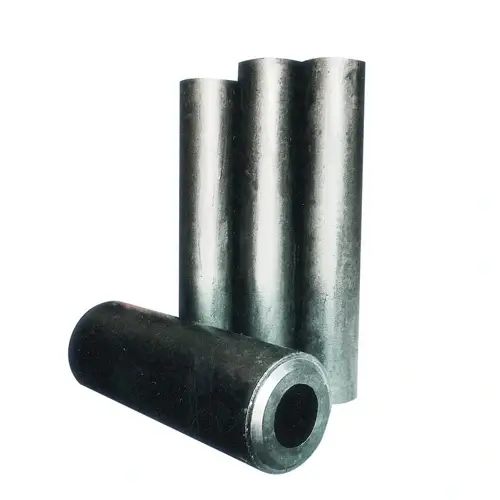
1.3 Performance Indicators of Low-Carbon Composite Steel Tape Bricks
The bulk density and apparent porosity of the samples were tested according to GB/T 2997—2000; the compressive strength at room temperature was tested according to GB/T 5072—2008; and the flexural strength at high temperature (held at 1400℃ for 0.5 h) was determined according to GB/T 3002—2017. The thermal shock resistance of the samples was tested using a water-cooling method: the fired samples were placed in a muffle furnace at 1100℃ for 30 min, removed, and rapidly cooled to room temperature in running water. The presence of cracks was observed. This process was repeated until cracks appeared in the samples to evaluate the material’s thermal shock resistance.
2.Results and Discussion
2.1 Mechanism of material performance improvement
Low-carbon composite tapping bricks outperform traditional high-carbon magnesia-carbon converter tapping bricks in various performance indicators, mainly due to the optimization of material formulation and preparation process. The following is a detailed analysis of the mechanisms by which these performance indicators are improved.
(1) Apparent Porosity: Apparent porosity and bulk density are important indicators for measuring the density of refractory materials. Low-carbon composite taphole bricks, through asphalt vacuum impregnation during preparation, significantly reduce apparent porosity and increase bulk density, making the material more compact at high temperatures, reducing the generation of pores and cracks, thereby improving overall mechanical properties and durability.
(2) Mechanical Properties: The flexural strength of low-carbon composite taphole bricks is improved at both room temperature and high temperature. This is mainly attributed to the addition of nano-alumina powder and boron nitride powder, which allows the material to form a more compact microstructure at high temperatures, improving the material’s strength and toughness.
(3) Antioxidant Properties: The low-carbon composite taphole bricks have nano-alumina powder, boron nitride powder, and boron carbide added to the inner layer. These additives can form a dense protective layer at high temperatures, preventing oxygen intrusion. Nano-alumina generates a dense Al₂O₃ protective layer at high temperatures, effectively slowing down the carbon oxidation rate. The excess alumina reacts with magnesium oxide at approximately 1100℃ during use to form MgO·Al₂O₃ spinel. This reaction, accompanied by volume expansion, densifies the internal structure of the sleeve refractory, inhibiting the infiltration of molten steel and slag. Boron nitride reacts with oxygen at high temperatures to form BN and B₂O₃, forming a multi-layered protective structure that further enhances oxidation resistance.
(4) Thermal shock stability: The low-carbon composite taphole brick uses high-carbon flake graphite in its outer layer, which helps absorb and alleviate thermal stress. Simultaneously, the nano-alumina powder and carbon black in the inner layer form a fine microstructure at high temperatures, improving the material’s thermal shock resistance and enabling the low-carbon composite taphole brick to withstand more thermal cycling shocks.
(5) High-temperature flexural strength: The key to improving high-temperature flexural strength lies in the material’s thermal stability and oxidation resistance. The different carbon content design of the inner and outer layers allows the outer layer to withstand higher thermal stress, while the inner layer has higher oxidation resistance, reducing carbon-oxygen reactions at high temperatures, thus maintaining the structural integrity and strength of the material.
(6) Service Life: The extended service life is due to the comprehensive improvement of the above-mentioned properties. Low apparent porosity and high bulk density improve the material’s corrosion resistance and structural stability, while high-temperature compressive strength and high-temperature flexural strength enhance the material’s resistance to mechanical and thermal shock. Furthermore, the radial layered design effectively distributes high-temperature and chemical corrosion stress, giving the material a longer service life in complex environments.
2.2 Influence of different process parameters on material properties
In this study, different process parameters significantly affected the material properties, as detailed below.
(1) Carbon content distribution: The outer layer had a carbon content of 14.7% (w), while the inner layer had a carbon content of 6%–10% (w). The higher carbon content in the outer layer helped absorb thermal stress and mitigate thermal shock damage, while the lower carbon content in the inner layer significantly improved the material’s oxidation resistance. This layered design ensured the material’s stability and durability under high-temperature conditions.
(2) Selection and proportion of additives: The rational use of additives such as nano-alumina powder, boron nitride powder, and boron carbide significantly enhanced the material’s density and oxidation resistance. Nano-alumina powder and boron nitride powder filled the micropores, reducing apparent porosity and increasing bulk density and strength. Boron carbide enhanced the material’s oxidation resistance and heat resistance.
(3) Molding process: Isostatic pressing ensured the material’s uniform density, reduced porosity generated during molding, and improved the material’s bulk density and mechanical strength. Simultaneously, precise control of molding pressure and time ensured the material’s uniform density. (4) Drying and Curing and Oil Immersion Treatment: Temperature and time control during the drying and curing process, as well as the selection of the medium and immersion time in the oil immersion treatment, significantly affect the final properties of the material. Drying and curing at 250℃ ensures the full curing of the internal binder, improving the material’s mechanical strength and thermal stability. Oil immersion treatment further enhances the material’s heat resistance and oxidation resistance.
Through the above optimized design and process control, the low-carbon composite taphole brick exhibits excellent performance across all indicators, particularly in oxidation resistance, thermal shock resistance, and service life, achieving significant improvements and providing an efficient and economical refractory material solution for converter steelmaking. Future research can further optimize material formulations and process parameters, explore broader industrial applications, and promote the development of low-carbon composite refractory materials.
3.Application of low-carbon composite tapping bricks in converter steelmaking
A novel low-carbon composite tapping brick has been applied in several steel plants, including Hebei Iron and Steel Group, with excellent results. Experiments show that this composite brick significantly outperforms traditional magnesia-carbon bricks in terms of oxidation resistance, thermal shock resistance, and service life, extending service life by an average of over 30%. This reduces replacement frequency and maintenance costs, improving the efficiency and stability of steelmaking production.
This low-carbon composite tapping brick is not only suitable for converter steelmaking but can also be widely used in electric arc furnace steelmaking and other high-temperature industrial applications, such as glass kilns and non-ferrous metal smelting. With the development of industrial technology and increasing environmental protection requirements, low-carbon refractory materials will have a broad market prospect, providing efficient and environmentally friendly solutions for related industries.
4.Conclusion
By optimizing the formulation and preparation process, a low-carbon composite tapping brick was successfully developed, exhibiting excellent mechanical properties and oxidation resistance under high-temperature and strong oxidizing environments. Specific experimental results show that compared with traditional high-carbon magnesia-carbon bricks, the service life of the low-carbon composite tapping brick is extended by approximately 30%. Future research can further explore the interaction mechanism of nanomaterials under high-temperature environments and the optimal ratio of different additives. Furthermore, the performance of the low-carbon composite tapping brick in the refining of different steel grades will be studied to further enhance its industrial application value.
 English
  简体中文
简体中文