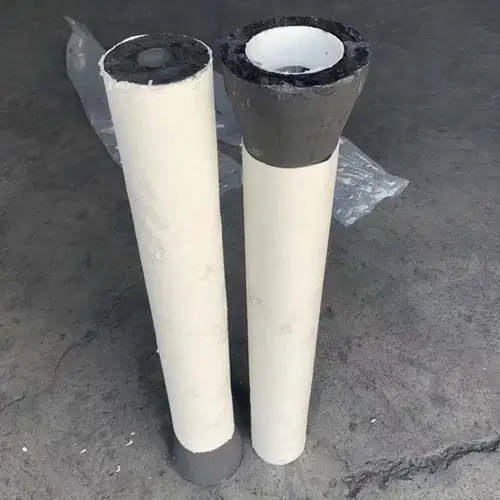
The long nozzle is a refractory channel connecting the ladle and the tundish. Its invention and application have played a pivotal role in the development of continuous casting technology and are closely linked to the effectiveness of protective casting from the tundish; specifically, it prevents secondary oxidation and contamination—originating from air, slag, refractory materials, or ladle opening sand—during both steady-state and non-steady-state casting processes.
1.The Evolution of Protected Casting Using Long Nozzles
In the early stages of continuous casting development, the primary technologies for addressing molten steel stream contamination were the argon sealing method and the ladle shroud. The argon sealing method involves passing the steel stream through a sleeve fixed to the tundish before it enters the tundish itself; the sleeve is equipped with argon inlets and outlets to maintain an inert atmosphere inside. Research indicates that this method effectively reduces gas absorption by the molten steel and improves the performance of mold flux. However, the method typically entails high argon consumption (650–1200 L/min), and splashed steel tends to deposit on the inner walls of the sleeve. Furthermore, if ladle slag is entrained in the steel stream, the pressurized argon can shatter and emulsify the slag, thereby increasing the risk of slag droplet entrapment. Consequently, the argon sealing method has not seen widespread adoption.
The concept behind the ladle shroud is to seal the steel stream within a narrow conduit to isolate it from the atmosphere. Ladle shrouds are relatively simple in structure and operation, operate independently of the tundish structure, and are widely used in modern continuous casting processes. An early study on ladle shrouds dates back to 1978, involving experiments at a continuous casting shop in Burns Harbor, USA. Researchers used fused silica to fabricate 48-inch and 60-inch shrouds, achieving excellent results: the total oxygen content in the tundish dropped from the 4×10⁻⁵–4.5×10⁻⁵ range to 2×10⁻⁵–2.5×10⁻⁵, and the yield of cold-rolled sheet increased from 85% to 97%. Additionally, the use of ladle shrouds effectively prevents steel splashing, reduces tundish maintenance costs, and improves safety conditions for operators. A drawback of the ladle shroud is that it requires replacement after the casting of each ladle.
To prevent air aspiration caused by negative pressure at the shroud connection, researchers introduced argon injection into the shroud’s bell (or “bowl”) section to create positive pressure. This innovation first appeared in a patent filed by Vesuvius in 1988 (US4836508A). In addition, the materials used for the body of the long nozzle have undergone continuous upgrading. The Burns Harbor plant in the United States initially experimented with both silica-based and alumina-carbon materials for long nozzles, but the latter were abandoned due to issues with thermal cracking. Similarly, the long nozzles first developed in my country in 1973 were silica-based, with a service life of approximately 8 hours; by early 1994, a preheat-free alumina-carbon long nozzle was successfully developed, offering a service life of around 9 hours. With continuous advancements in raw materials, manufacturing processes, coating technologies, and production equipment, preheat-free alumina-carbon refractories have become a dominant material for long nozzles in modern continuous casting, achieving service lives exceeding 40 heats.
2.Structural Design of Long Nozzles and Tundish Shrouded Casting
2.1 Industrial-scale long nozzle
The original design for the long nozzle featured a straight-bore structure—that is, a constant internal diameter. Due to its simple design, lightweight nature, ease of handling, and ease of manufacture, this type remains in use at many steelmaking plants. However, a major drawback of the straight-bore nozzle is its inability to facilitate submerged casting initiation. During submerged casting initiation, the outflow of opening sand from the ladle bottom creates negative pressure within the nozzle, causing molten steel from the tundish to backflow into the nozzle. Combined with the impact of the incoming steel stream, this creates high gas pressure in the nozzle’s “bowl” section, leading to steel splashing or even accidents. Conversely, with non-submerged casting initiation, the steel stream exiting the nozzle strikes the tundish covering flux first, causing violent entrainment and mixing of the steel and flux in the impact zone; the entrained flux and air serve as primary sources of contamination during the casting initiation and ladle exchange phases.
To enable submerged casting initiation, Becker and Prabhu developed and implemented a flared long nozzle at Inland Steel Company in the United States in February 1989. A key feature of the flared nozzle is its larger exit diameter and greater internal volume. During casting initiation, the negative pressure head caused by the opening sand is 45 mm—approximately one-fifth that of the corresponding straight-bore nozzle (which is 217 mm). Consequently, the flared expansion section accommodates more hot air and molten steel, helping to prevent backflow and splashing during startup. Following the adoption of submerged casting initiation, steel cleanliness improved significantly, folding defects at the company’s cold-rolling mill decreased, and clogging issues at the tundish nozzle were alleviated.
Metallurgical researchers have subsequently documented the numerous advantages of the flared long nozzle, primarily regarding increased production efficiency and improved steel quality. For instance, the flared nozzle produces a lower exit velocity and exerts less impact force on the tundish melt pool, thereby reducing erosion of the refractory lining in the impact zone. This results in more favorable flow characteristics within the tundish, a calmer melt pool surface, and a higher proportion of plug flow. Given their numerous advantages, trumpet-shaped submerged entry nozzles (SENs) are currently widely used in regions and countries such as Europe, the United States, Japan, and South Korea. Major Chinese steel enterprises—including Baosteel, Shougang, Laigang, and Tanggang—have also adopted this type of nozzle. In my country, trumpet-shaped nozzles are primarily utilized for steel grades requiring high molten steel quality, such as IF steel and bearing steel, whereas their application in ordinary carbon steel remains limited. While these nozzles offer significant benefits, realizing their full potential requires proper design and usage; the height of the trumpet section and the outlet diameter are critical design parameters. An excessive expansion angle can actually lead to flow deflection and backflow issues during the start of casting or ladle exchange, thereby increasing the risk of secondary oxidation and slag entrapment. Additionally, a single trumpet-shaped nozzle is heavier than a straight-bore type (by approximately 10%) and is less convenient to handle; however, with advancements in refractory material performance and the implementation of automated handling technology, the trumpet-shaped nozzle warrants broader promotion and application to facilitate the stable production of high-quality steel.
2.2 Novel Long Nozzle Structure
In addition to optimizing existing industrial-scale ladle shrouds, metallurgists are also developing new types of ladle shrouds. Several typical designs for these new shrouds can be found in the literature; most are based on the concept of optimizing the flow field of molten steel within the shroud and the tundish, thereby enhancing steel cleanliness.
3.Process Operation and Protective Casting Using Long Nozzles
The operational practices associated with the long nozzle are also closely linked to the effectiveness of protected casting; this is primarily reflected in the nozzle’s immersion depth within the tundish melt pool and issues regarding its alignment (or inclination).
3.1 Immersion depth of the long nozzle
When initiating casting with a flared long nozzle, the nozzle is typically submerged to a shallow depth in the tundish melt pool before the slide gate is opened to commence submerged casting. During steady-state casting, the immersion depth of the long nozzle is determined by the depth of the tundish melt pool, the length of the nozzle, and the position of the ladle. From a fluid dynamics perspective, the immersion depth primarily dictates where the turbulent kinetic energy of the nozzle jet is dissipated. Specifically, the jet velocity exceeds the flow velocity in any region of the tundish melt pool; upon impact, the jet mixes with the molten steel, causing the turbulent kinetic energy to dissipate and diminish. If the immersion depth is shallow, the dissipation occurs near the melt surface, potentially causing surface fluctuations or even entraining the covering flux into the melt pool. Conversely, if the immersion depth is deep, the dissipation occurs at a lower level, intensifying erosion of the refractory lining at the tundish bottom; simultaneously, the upward return flow velocity increases, which may displace the covering flux layer and expose a large area of the molten steel surface.
3.2 Misalignment of the long nozzle
Ideally, the long nozzle should be vertically aligned and form a tight, airtight seal with the ladle’s bottom nozzle. However, in actual production, equipment such as ladles, turret arms, and tundishes involves heavy machinery, making precise horizontal positioning difficult. Factors such as frequent replacement and horizontal shifting of the bottom nozzle, along with wear on the long nozzle’s bell-shaped inlet (or “bowl”), often lead to nozzle misalignment. While the degree of misalignment varies depending on operating conditions, the incidence rate is high—exceeding 90%—making it a significant issue in continuous casting. The adverse effects of long nozzle misalignment manifest in four main ways: first, a poor seal at the inlet connection can lead to air aspiration or excessive localized stress, damaging the nozzle; second, it can cause localized erosion and excessive thermal stress on the nozzle; third, a deflected outlet jet increases shear stress on the tundish melt surface, raising the risk of slag entrapment and exposure of the slag layer; and fourth, severe misalignment may direct the jet into areas of the tundish lacking turbulence inhibitors, causing severe erosion of the tundish bottom and the formation of short-circuit flows.
To address the issue of long nozzle misalignment, one approach is to modify the mechanical design by replacing the dual-plate sliding gate mechanism with a three-plate system; this design eliminates misalignment caused by the horizontal shifting of the bottom nozzle. However, the three-plate system entails higher costs and is more commonly used with submerged entry nozzles. From an operational standpoint, misalignment-induced contamination during low-level casting can be mitigated by minimizing ladle exchange times or by raising the tundish melt level at the end of the previous heat.
4.Multifunctional Evolution of the Long Nozzle During the Tundish-to-Mold Protective Casting Process
With the development of continuous casting technology and the continuous upgrading of equipment, the long nozzle is exhibiting a trend toward functional diversification during the protective casting process from the tundish, primarily manifested in the following aspects.
(1) Implement vibration-based slag carryover detection
During the final stage of ladle pouring, slag carryover from the ladle can severely contaminate the molten steel in the tundish. To rapidly detect the onset of slag carryover, common detection technologies include electromagnetic, weight-based, and ultrasonic methods. Among these, electromagnetic detection is widely used due to its high precision and sensitivity; however, it typically entails high construction and maintenance costs, involves complex equipment structures, and suffers from a relatively short service life. Japanese researchers at Kawasaki Steel Corporation first introduced “vibration-based slag detection” in the 1980s. This technique identifies slag entrainment by mounting a vibration sensor on the long nozzle’s operating arm and monitoring differences in vibration signals caused by the molten steel and slag flowing through the nozzle, thereby enabling the timely closure of the slide gate to prevent slag carryover. In the early days of continuous casting, operators would manually sense changes in nozzle vibration by touching the operating arm or an iron rod held against the long nozzle. Vibration-based sensors offer superior accuracy and reliability; they are particularly sensitive to funnel-shaped slag vortices and are relatively easy to install and maintain, leading to their widespread adoption across the industry.
(2) Generation of dispersed bubbles to remove inclusions
Injecting argon gas into the bowl section of the long nozzle not only prevents air aspiration at the connection point but also serves as an effective means of removing inclusions from the molten steel. Smaller bubbles possess a larger specific surface area, which—within a certain range—is more conducive to capturing inclusions. Conversely, larger bubbles reduce the probability of collision with inclusions and may cause significant surface turbulence in the tundish. Therefore, the aim in actual production is to generate small, finely dispersed bubbles. Experimental results indicate that the size of argon bubbles within the long nozzle generally ranges from several hundred micrometers to a few millimeters. Bubble size is influenced by factors such as the gas inlet dimensions, wettability, the properties of the molten steel, and the relative velocity between the bubbles and the steel melt.
(3) Solving the problem of contamination of the drainage sand
There is currently no effective solution in actual production to address the issue of contamination caused by free-opening sand entering the molten steel. Since the sand passes through the long nozzle before entering the tundish melt, the long nozzle presents a key opportunity to mitigate this contamination problem. This approach involves two main strategies: first, designing a flow-guiding channel at the bottom of the long nozzle to prevent the sand from entering the tundish melt during the start of casting—though this method often causes intense splashing of molten steel, compromising operational safety; and second, designing appropriate long nozzles and tundish flow-control devices to enhance the efficiency of floating and removing the sand within the tundish.
5.Summarize
The invention of the long nozzle (or ladle shroud) stemmed from the need for protected pouring of molten steel; its use effectively prevents secondary oxidation and slag entrapment, playing a pivotal role in the evolution of continuous casting. Contamination of molten steel in the tundish—observed across various stages of continuous casting development—is frequently linked, directly or indirectly, to the long nozzle, a topic that has increasingly drawn the attention of metallurgical professionals. In recent years, long nozzles have undergone continuous upgrades in terms of materials, structural design, and operational practices. Innovative designs—particularly the development and application of trumpet-shaped nozzles—have enabled submerged casting starts, effectively mitigating the severe slag entrapment and gas absorption often associated with the initiation of the casting process. Experimental research has helped establish optimal ranges for nozzle immersion depth. Misalignment of the long nozzle occurs frequently; severe misalignment complicates protected pouring from the ladle to the tundish, but solutions can be implemented through structural design improvements, optimization of continuous casting processes, and automated identification and control of nozzle positioning.
As continuous casting technology advances, refractory materials are being tasked with a broader range of metallurgical functions, and the role of the long nozzle has become increasingly multifaceted—encompassing capabilities such as ladle slag detection, the generation of dispersed gas bubbles, and the prevention of contamination by opening sand. Future developments will balance structural design with the integration of these diverse metallurgical functions—reflecting a trend toward the unification of structure and function—while the primary objective remains the effective protected pouring of molten steel.
 简体中文
简体中文  English