
Magnesium rammed refractories are produced using an oxygen-enriched side-blown melting pool process. The primary equipment consists of an oxygen-enriched side-blown melting pool furnace, a settling electric furnace, and a continuous refining furnace, arranged sequentially from highest to lowest temperature. The molten material flows through channels between each furnace. This process represents a new, highly efficient, energy-saving, and environmentally friendly technology. Magnesium rammed refractories are primarily used in the furnace roof of electric furnaces and the riser flue of oxygen-enriched side-blown furnaces.
Electric furnace roof
Electric furnaces hold a crucial position in the metallurgical industry. Electric furnace lids operate under demanding conditions in harsh environments, frequently subjected to high temperatures, slag erosion, and rapid thermal cycling, making them prone to damage. The lifespan of these lids directly impacts the furnace’s production efficiency.
Initially, electric furnace roofs were constructed using silica bricks. In the late 1960s, high-alumina materials began to be trialed. These materials demonstrated superior refractoriness, high-temperature erosion resistance, and thermal shock stability compared to silica bricks. After the 1990s, monolithic precast furnace covers made of high-alumina or corundum refractory castables reinforced with steel fibers became widely adopted in the electrode triangle zones. However, no reports have been found regarding the use of magnesia rammed refractories as furnace roof materials.
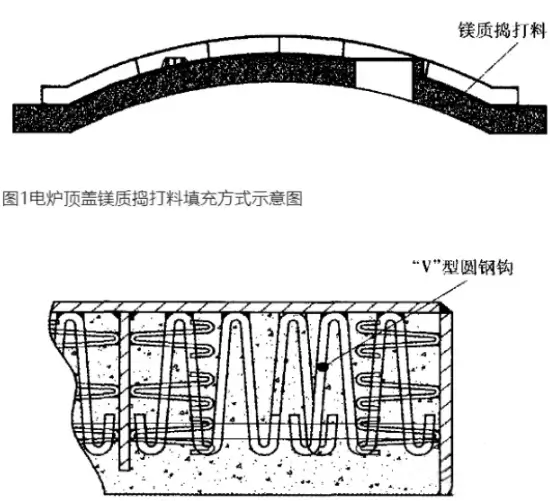
Unlike monolithic roof structures, the electric furnace roof comprises multiple roof blocks. Each block is a hollow arched module fabricated by welding ordinary steel plates, with both ends flush and level with the furnace walls. Numerous “V”-shaped nails are welded inside the roof blocks to enhance the structural integrity of the magnesia rammed refractory.
During construction, the hollow side of the roof block faces upward. Prepared magnesia rammed refractory is manually filled into the module, spread evenly with a shovel, and compacted to remove air pockets. The rammed refractory thickness aligns flush with the roof edge. Simultaneously, small wooden sticks are inserted into the rammed refractory. This facilitates drying and allows for continuous monitoring of the drying progress. The presence of the arched structural frame and “V”-shaped round steel hooks significantly reduces the labor intensity of manual tamping. Once filled, the roof blocks can be left in a well-ventilated area to dry naturally without requiring heating or drying. The filling method for the magnesium rammed refractory in the electric furnace roof cover is shown in the figure, and the connection method between the “V”-shaped round steel hooks and the magnesium rammed refractory is illustrated in the figure.
During use, the furnace roof blocks are directly installed onto the furnace roof without requiring additional water-cooling facilities.
Following a furnace shutdown after one production cycle (500 days), inspection of the electric furnace roof revealed excellent integrity of the magnesium rammed refractory. No cracks or spalling were observed after forced cooling. It exhibits high strength in the cold state, with the thinnest sintered section located near the electrodes. Consequently, this magnesium rammed refractory demonstrates excellent high-temperature resistance and resistance to melt erosion after sintering.
Using magnesium rammed refractory as furnace roof material offers the following advantages:
(1) Magnesia rammed refractories feature a simple composition that can be readily replaced, with costs amounting to only one-quarter of standard castable refractories;
(2) Following the adoption of magnesia rammed refractories, electric furnace roofs no longer require full-coverage filling. The segmented roof structure facilitates safer and more convenient lifting operations, simplifying furnace condition monitoring and emergency response;
(3) Magnesium rammed refractories exhibit superior high-temperature resistance, eliminating the need for auxiliary water-cooling systems in electric furnaces. This reduces energy consumption and ensures production safety;
(4) Magnesium rammed refractories maintain uniform composition, preventing damage from differential thermal expansion during use and guaranteeing service life.
Oxygen-enriched side-blown furnace flue gas outlet copper water jacket
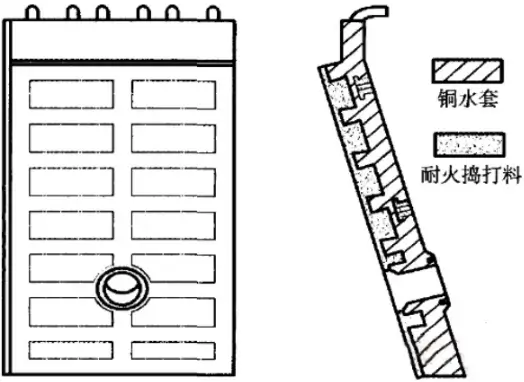
The copper water jacket at the flue gas outlet is positioned below the rising flue, serving as the connection between the furnace body and the water-cooled walls of the waste heat boiler. This water-cooled component is a large copper water jacket, directly secured to the outer steel structure with heavy-duty bolts for easy disassembly and installation. Grooves added to the inner wall allow the magnesia rammed refractory lining to adhere firmly to the water jacket (as shown in the figure). The presence of the rammed refractory significantly enhances the safety of the copper water jacket, enabling direct oil firing for temperature ramp-up during furnace startup.
Currently, the smelting industry is developing rapidly, with each enterprise exhibiting distinct characteristics in the use of unshaped refractory materials. The oxygen-enriched side-blowing process employs custom-formulated magnesia rammed refractories in different sections, reducing production costs while ensuring process integrity. After multiple furnace cycles of refinement, the application of magnesia rammed refractories has become increasingly optimized. The advantages of using this material are as follows:
(1) Uniform corrosion of refractories ensures safe production. Current refractory lifespan has reached 500 days.
(2) When used as electric furnace roof refractories, it reduces process costs, ensures safe and convenient operation, and lowers energy consumption.
(3) When used as copper water jacket packing, it ensures the safety of the copper water jacket.
Although the application of magnesium rammed refractories has been relatively successful, the mechanism of their erosion remains unclear. To further optimize the performance of magnesium rammed refractories, it is essential to analyze their erosion mechanism, which will be a key focus for future work.
 简体中文
简体中文  English