
The main raw materials for magnesia refractories are magnesite, dolomite, and brucite. These minerals are abundant in my country’s natural resources, primarily distributed in coastal areas such as Liaoning, Shandong, and Hebei provinces, providing a favorable resource foundation for the development of magnesia refractories in my country. This has made China the world’s largest producer and exporter of magnesia refractories. Magnesia refractories possess numerous advantages, including high melting points, excellent high-temperature volume stability, and good mechanical properties, and have been widely used in high-temperature industries such as steel, metallurgy, building materials, and ceramics. Different high-temperature industrial sectors have varying requirements for the types of magnesia refractories to select. Generally, magnesia refractories are classified according to their chemical composition into magnesia-carbon refractories, magnesia-calcium refractories, and magnesia-alumina refractories, among others, with different properties and applications. Furthermore, the performance of different types of magnesia refractories is a decisive factor in determining whether high-temperature industrial kilns can maintain long-term, normal, and stable production.
To adapt to the rapid development of high-temperature industries, the requirements for kiln lining materials are becoming increasingly stringent. Traditional magnesia refractories can no longer meet the standards for high-performance refractories. Utilizing nanotechnology to prepare high-performance multiphase materials to improve material properties has significant research value. Currently, nanotechnology, due to its surface effects, small size effects, quantum size, and macroscopic quantum tunneling effects, has been widely applied in the field of refractory materials, successfully preparing lightweight and multifunctional multiphase refractories. Using nanotechnology to prepare multiphase magnesia refractories can alleviate the demand for high-performance magnesia materials in high-temperature industries, while also achieving the lightweighting and multifunctionality of magnesia refractories, thereby increasing product added value. Undoubtedly, the emergence of nanotechnology provides favorable conditions for the preparation and modification of high-end magnesia refractories.
Based on this, this paper reviews the current research status of nanotechnology in magnesium refractories with different chemical compositions both domestically and internationally, elucidates the mechanism of nanotechnology in magnesium refractories, summarizes the problems existing in the application of nanotechnology in magnesium refractories, and looks forward to its future development direction, providing some inspiration for scholars dedicated to the research of magnesium refractories.
Application of nanotechnology in low-carbon magnesium carbonaceous refractories
Magnesia-carbon refractories are furnace lining materials mainly used in converters, electric furnaces, and ladles. Carbon plays a crucial role in the high-temperature steelmaking process due to its high thermal conductivity, low coefficient of thermal expansion, and low wettability to molten slag, thus improving resistance to slag erosion and thermal shock resistance. Traditional magnesia-carbon refractories, due to their high carbon content, suffer from significant heat loss and are prone to oxidation during use, hindering the production of high-quality steels such as clean steel and special steels, and ultimately failing to meet their application requirements. Therefore, low-carbonization is a major development trend for magnesia-carbon refractories. However, for low-carbon magnesia-carbon refractories, the lower carbon content results in poorer slag resistance and thermal shock resistance, leading to failure primarily through slag erosion and surface cracking or spalling. Therefore, research on the preparation of high-performance low-carbon magnesia-carbon refractories using nanotechnology will mainly focus on improving slag resistance and thermal shock resistance.
Slag resistance
Low-carbon magnesia-carbon refractories are mainly composed of composite materials made of magnesia sand, graphite, carbonaceous binders, and antioxidants. Research on enhancing the slag resistance of low-carbon magnesia-carbon bricks using nanotechnology focuses primarily on two aspects: strengthening the matrix structure with nano-carbon and modifying the carbonaceous binder with nano-catalysts.
In the process of reducing the carbon content of magnesia-carbon refractories, nano-carbon is often introduced as a raw material to improve the slag resistance and thermal shock resistance of the products. This is because nano-carbon has a large specific surface area, high reactivity, and small particle size, which enhances the direct bonding strength between particles. The introduction of nano-carbon can achieve the following strengthening mechanisms for the matrix structure: (1) The shape of nano-carbon particles is closer to spherical. It has good fluidity, better promoting sintering and filling voids to improve the strength of the product, thereby achieving the goal of improving the slag resistance of the product. (2) Nano-carbon forms whiskers, fibers, or ceramic phases in situ with the material components, significantly increasing the strength of the product and improving the erosiveness of the molten slag. Bag et al. used high-purity fused magnesia, natural graphite, and nano-carbon black as raw materials to prepare low-carbon magnesia-carbon refractories using traditional refractory sintering processes. They compared the performance of magnesia-carbon products prepared from nano-carbon black and natural graphite composite powders with traditional magnesia-carbon products. The results showed that, compared to traditional magnesia-carbon products, the low-carbon magnesia-carbon products with the added nano-carbon black (0.9% by mass) and natural graphite (0.3% by mass) composite powders had a relatively narrow particle size distribution and better flowability, resulting in better density and higher mechanical strength, thus improving the product’s resistance to slag erosion. This can be attributed to the nano-carbon black filling the gaps between large particles, forming a denser packing. Ding et al. prepared nano-carbon black composite powders using nano-carbon black, boron carbide, and alumina as raw materials, which resulted in low-carbon magnesia-carbon refractories exhibiting good slag resistance. As shown in Figure 1, the sample numbers were divided into three groups according to the different methods of preparing the nano-carbon black composite powders:
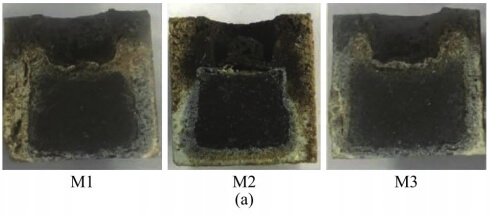
M1 is a non-composite powder, M2 is a composite powder prepared by mechanical methods, and M3 is a composite powder prepared by combustion methods. The results show that, compared with the sample without composite powder, the sample containing nano-carbon black composite powder exhibits stronger resistance to slag erosion. This is because the nano-carbon black composite powder has a large specific surface area, promoting sintering densification and improving the bonding strength of the sample, thus resisting the penetration of high-temperature slag.
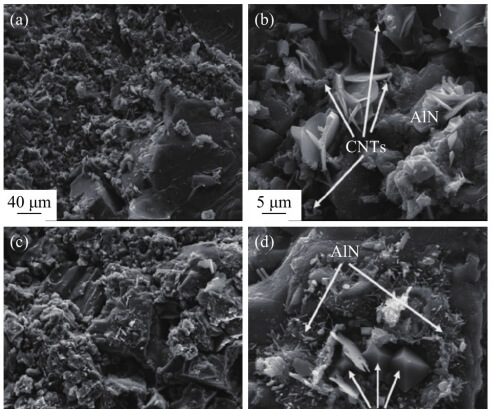
Zhu et al. selected two different nano-carbons (carbon nanotubes and nano-carbon black) to study the effect of their type on the properties of low-carbon magnesium carbonaceous refractories. Figure 2 shows SEM images of the cross-sections of samples with carbon nanotubes (CNTs) and nano-carbon black (CB) after carbonization treatment at 1400℃. The SEM images show that in-situ formed lamellar (in CNTs) or needle-like (in CB) AlN and octahedral MgAl₂O₃ ceramic phases intertwine and interweave, making the material more dense, improving the microstructure of the sample, and effectively preventing further erosion reactions.
In traditional carbon-magnesium refractories, the bonding between different particles relies on the chemical cross-linking reaction of carbonaceous binders such as coal tar, pitch, and phenolic resin. The resulting cross-linked network structure acts as a bridge, allowing particles to cross-link and forming an interlocking network structure. However, low-carbon magnesium refractories, due to their low carbon content, struggle to achieve a continuously distributed network structure, leading to reduced direct bonding strength between particles. Therefore, modification of the carbonaceous binder is a key factor affecting the performance of low-carbon magnesium refractories.
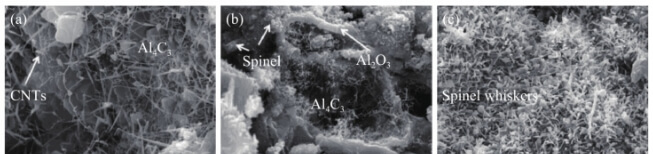
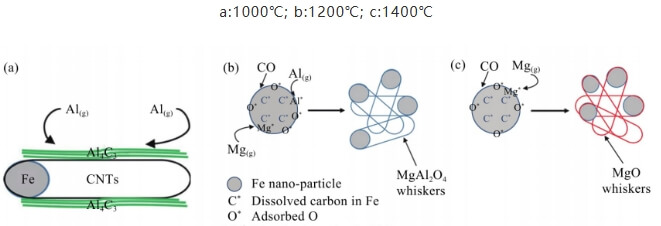
Currently, the in-situ synthesis of carbon nanotubes, carbon nanofibers, and ceramic phases using catalyst-modified carbonaceous binders can effectively improve the performance of low-carbon magnesium refractories. Wang Junkai of Wuhan University of Science and Technology prepared high-strength, low-defect carbon nanotubes using an in-situ synthesis method combined with a Fe and Co nanoparticle-catalyzed phenolic resin pyrolysis process. Figure 3 shows a SEM image of the product after being held at 1000℃ for 3 hours with the addition of Fe (1% by mass) and Co (1% by mass) catalysts. Microstructurally, carbon nanotubes exhibit a clustered distribution, encapsulating MgO particles in an interwoven manner, blocking the internal pores of the particles, leading to increased material strength and improved resistance to slag erosion. Rastegar et al. used nano-Fe-modified phenolic resin as a binder to prepare low-carbon magnesium-based refractories. SEM images (Figure 4) revealed that the sample (MC₃) modified with nano-Fe (7% by mass) generated a large number of carbon nanotubes (CNTs), MgO whiskers, MgAl₂O₄ whiskers, and Al₄C₃ ceramic phases in situ at 1000-1400℃, enhancing the bonding strength of the network structure. This is precisely why the low-carbon magnesium-based refractories improved their resistance to slag erosion. Figure 5 shows a schematic diagram of the reaction mechanism for the in-situ formation of the Al₄C₃ ceramic phase, MgAl₂O₄ whiskers, and MgO whiskers.
Thermal shock resistance
In addition to good slag resistance, low-carbon magnesia-carbon refractories also require good thermal shock resistance, as reducing carbon content drastically decreases thermal shock resistance. Thermal shock resistance is not only an important indicator for evaluating refractories but also a key research direction in the low-carbon application of magnesia-carbon bricks. Nanoparticles, due to their small size, high surface energy, and high dispersion, facilitate relative slippage between particles, thus improving thermal shock resistance. Therefore, utilizing nanotechnology to improve the thermal shock resistance of low-carbon magnesia-carbon refractories has attracted considerable attention.
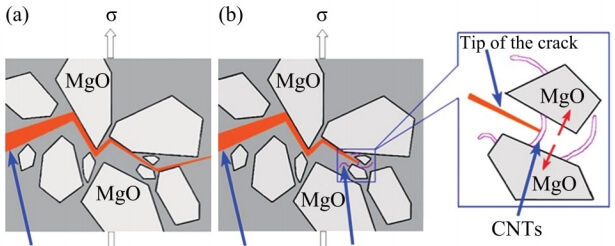
Improving the thermal shock resistance of low-carbon magnesia-carbon refractories using nanotechnology essentially involves increasing the material’s fracture toughness. This can be achieved by adjusting the material’s microstructure to further enhance crack propagation resistance. There are two main toughening methods for low-carbon magnesium-carbon refractories: (1) Crack deflection toughening: Nanoparticles are introduced as raw materials or additives. These nanoparticles are dispersed within or between particles, forming numerous sub-interfaces and acting as pinning dislocations, making the crack propagation path more tortuous and prolonging the path. This leads to increased energy consumption during crack propagation, increasing the material’s fracture toughness. (2) Crack bridging toughening: Introducing nanoparticles into the aggregate of the refractory material can form bridging components of fibers, whiskers, and ceramic phases in situ. When a large bridging component is encountered during crack propagation, it acts as a bridge between two opposing crack surfaces, increasing the resistance to crack propagation. If the crack continues to propagate further, the bridging component is destroyed by being pulled out of the matrix. This pulling-out process consumes a large amount of energy, improving the fracture toughness of the product and thus improving its thermal shock resistance. It was found that samples prepared using multilayer nano-graphite-magnesium aluminum spinel composite additives have high room temperature flexural strength and residual strength. The introduction of this composite additive can inhibit grain growth and alleviate thermal stress caused by its own non-uniform structure. At the same time, magnesium aluminum spinel, as a second phase, plays a role in crack deflection and toughening (Figure 6).
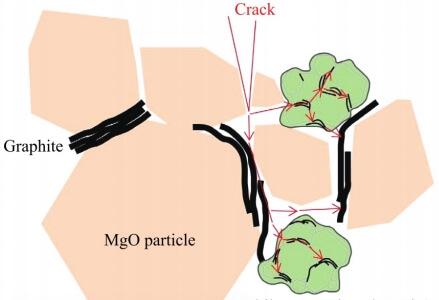
Using Al and Ni catalyst-modified phenolic resin as a binder, carbon nanotubes and ceramic phases with high strength and elastic modulus are formed in situ in low-carbon magnesia-carbon refractories. The synergistic effect of the pinning and interlocking structure of the carbon nanotubes and ceramic phases significantly improves the mechanical properties and thermal shock resistance of the product. Wei et al. prepared magnesia-carbon refractories with excellent comprehensive properties using nano-Fe-modified phenolic resin as a binder via in-situ synthesis. From the sample strength and toughness models shown in Figure 7, it can be seen that the improved strength and toughness of the magnesia-carbon refractories can be attributed to the bridging and crack deflection of the in-situ formed carbon nanotubes.
 English
  简体中文
简体中文