The use of refractory materials for converter linings directly affects the safety, operation, and production of steel plants, and significantly impacts steelmaking costs. Advanced steel plants and refractory material suppliers consider converter refractory material consumption as a key performance indicator. Currently, the most intuitive and scientific way to measure converter refractory consumption is by ton-of-steel consumption, which is the amount of converter lining and maintenance materials consumed per ton of molten steel produced. In modern converter smelting processes, Japanese converters can control refractory material consumption to 0.41~0.91 kg/t of steel (including lining and maintenance materials). Currently, the 250t converter at an Indian steel plant, contracted by Wuhan Iron and Steel Refractory Company, has achieved a ton-of-steel consumption of 0.7 kg/t of steel across its entire service life (8000 heats). For converters, the steel plant’s steelmaking philosophy, production rhythm, converter lining quality, converter lining construction, converter operation, optimization of magnesia-carbon brick matching, and daily maintenance and construction quality are crucial factors in achieving lower refractory material consumption.
This practice addresses the high refractory material consumption in a 210t converter at a domestic steel plant, a project undertaken by Wuhan Iron and Steel Refractories Co., Ltd., where the total refractory material consumption was 0.98 kg/t of steel. A comprehensive optimization scheme for the converter’s overall contracting was developed, along with corresponding measures. Through optimized converter furnace design, refractory material matching, and final slag control, the total refractory material consumption was reduced to 0.87 kg/t of steel.
1.Specific measures for converter optimization
2.1 Converter furnace design optimization
The permanent layer of the bottom of a 210t converter in a steel plant is designed to be 195mm thick, the thickness of the magnesia-carbon bricks in the working layer of the bottom is 800mm, the furnace volume ratio is 0.86m³/t, and the working layer has a smooth arc transition from the center brick to the molten pool. The center brick of the bottom is at the lowest position, as shown in Figure 1.
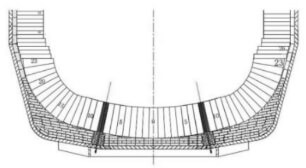
With the increasing demand for high-purity steel from steel companies, the bottom blowing flow rate of converters has gradually increased in recent years. This results in high operating pressure at the converter bottom, and the arc-shaped brickwork starting from the center of the bottom with a steep slope around the perimeter causes erosion of the bottom bricks from the center bricks, gradually spreading to the top 10 rings. At 3500 heats per converter, the residual thickness is 600-700 mm (including the permanent layer), with an erosion rate of approximately 0.11 mm/heat. This leads to high maintenance costs and affects the converter’s operating efficiency. The existing bottom working layer design can no longer meet the smelting needs of steel plants. Therefore, the furnace type has been optimized and modified, as shown in Figure 2.
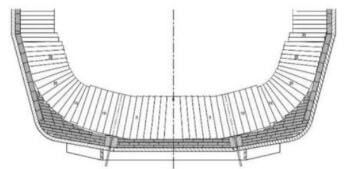
In 2022, the furnace design was optimized and adjusted, with the working layers of rings 1-13 at the furnace bottom thickened to 1000mm. Furthermore, rings 1-6 at the furnace bottom were designed in a “flat-bottomed pot” shape, with the working layer bricks tightly adhering to the permanent layer in a ring extending to the 6th ring at the furnace bottom, and a gradual arc transition starting from the 7th ring. In the optimized design, the center brick is no longer the lowest point; from the center brick at the furnace bottom to the 6th ring, the entire surface is flat, collectively bearing the responsibility for stirring the molten steel and applying static pressure.
2.2 Optimization of Refractory Material Matching for Converters
Different converters, due to varying iron compositions, smelting processes, steel grades, and auxiliary equipment, experience rapid erosion in certain localized areas during operation. To reduce the erosion rate during converter operation and minimize insufficient residual thickness upon completion, material optimization is performed on both overall and localized components during the converter material design process.
Since its inception, magnesia-carbon bricks have been widely used in various steelmaking kilns due to the non-wetting properties of graphite and slag, as well as their excellent thermal conductivity, resulting in superior resistance to slag erosion and thermal shock stability. The current national standard for magnesia-carbon bricks (GB/T22589—2017) classifies them into 26 grades with 7 different carbon contents. Currently, the main magnesia-carbon brick grades used in the converters contracted by Wuhan Iron and Steel Refractories Co., Ltd. are: MT-10A, MT-12A, MT-14A, MT-16A, and MT-18A. Because different steel mills employ different smelting processes and use different steel grades, selecting the appropriate magnesia-carbon brick grade is crucial. Domestic research indicates that the decarburized layer thickness of ordinary magnesia-carbon bricks is 2.4 times that of low-carbon magnesia-carbon bricks. Furthermore, compared to high-carbon materials, low-carbon magnesia-carbon bricks have smaller interparticle spacing between MgO particles, making it easier to form a MgO-rich reaction layer on the working surface. After oxidation, the magnesia-carbon bricks become denser and exhibit better oxidation resistance.
Therefore, Wuhan Iron and Steel Refractory Company has conducted a series of verification tests on converter magnesia-carbon bricks with carbon contents of 12%, 14%, and 18%.
A steel plant primarily produces low-carbon steel (average tap carbon content of 0.04%). Through experiments, the material matching scheme for magnesia-carbon bricks in the converter of this steel plant was determined, as shown in Table 2. The furnace bottom, front face, and molten pool working layer require good erosion resistance due to the agitation caused by molten steel during operation; therefore, the carbon content of the magnesia-carbon bricks was adjusted to MT-12A. The magnesia-carbon bricks in the rear face, due to their longer contact time with molten steel, require good oxidation resistance and corrosion resistance; therefore, the material scheme was adjusted from MT-18A to MT-14A.
2.3 Converter final slag control
Using high-quality converter refractory materials is fundamental to the safe and smooth operation of a converter, and is also closely related to appropriate converter operation and on-site maintenance. Different compositions of molten iron (Si, Mn, P content), converter smelting lance position, and especially slag splashing operation and ratio, final composition, and final slag control all have a certain impact on converter lining erosion.
The main substances affecting the melting point of converter slag are FeO, MgO, and basicity. Currently, a steel plant typically uses 15%–20% TFe. Under a certain TFe ratio, the higher the basicity and MgO content in the final converter slag, the higher the melting point and the more viscous the slag. From a furnace protection perspective, this is more beneficial to the furnace lining. For cost considerations, steel plants generally control the converter basicity between 2.8 and 3.2.
After optimization, the converter begins slag splashing for furnace protection from the moment it is started, with a total slag splashing rate of 98.4% throughout the entire furnace service. The average slag splashing time is 2.68 minutes, and the slag splashing rate throughout the entire furnace service is 14.8% higher than before optimization.
3.1 Decreased erosion rate
Before optimization, the bottom thickness measurement data of a 210t converter at a steel plant showed an erosion rate of 0.046 mm/heat, and the working layer thickness at the bottom was approximately 400 mm. In the early stages of operation, erosion was significantly faster within a 1.5m radius around the central brick.
After implementing a series of measures, including optimizing the furnace bottom and shape, optimizing refractory material matching, and controlling the final slag in the converter, furnace 7525 was successfully completed. The thickness measurement data for the entire furnace operation is shown in Figure 7. The erosion rate was 0.037 mm/furnace, which was significantly slower than before optimization. Furthermore, no significant drop in the center brick was observed in the early stages of converter operation. The bottom blowing elements were completed simultaneously with the converter.
3.2 Reduced maintenance costs
After implementing a series of measures, including optimizing the furnace bottom design, optimizing refractory material matching, and controlling converter final slag, the converter maintenance material consumption is shown in Figure 8. The cost of rear surface maintenance material decreased from 0.4 kg/t steel to 0.35 kg/t steel, a reduction of 0.05 kg/t steel; the cost of furnace bottom maintenance per ton of steel decreased from 0.25 kg/t steel to 0.17 kg/t steel, a reduction of 0.08 kg/t steel. The total converter maintenance consumption decreased by 0.13 kg/t steel. The total reduction in maintenance consumption during the furnace service was 210 tons.
3.3 Improved converter utilization efficiency
As the consumption of converter maintenance materials decreased, the converter maintenance time also decreased. The maintenance time for the rear face was reduced by 41 hours, and for the furnace bottom by 66 hours, resulting in a total saving of 107 hours. However, due to the increased slag splashing ratio in the converter, maintenance time increased by 38 hours, reducing the proportion of converter maintenance in total operating time from 13.8% to 13.2%, and improving converter utilization efficiency by 0.6%.
For a flat-bottom converter in a steel plant, designing the furnace bottom as flat-bottomed can slow down the erosion rate at the center of the furnace bottom. By thickening the working layer at the furnace bottom from 800mm to 1000mm and changing the furnace shape, the average erosion rate of the furnace bottom throughout the entire service life decreased from 0.11mm/heat to 0.085mm/heat, a reduction of 22.7%.
For converters used in low-carbon steel smelting, appropriately reducing the carbon content of the magnesia-carbon bricks at the furnace bottom and rear large surface areas can slow down erosion at the furnace bottom and rear large surface areas.
Appropriately adjusting the basicity and MgO content of the converter’s final slag and increasing the proportion of slag splashing throughout the entire service life can effectively reduce converter maintenance.
After implementing a series of measures, including optimizing the furnace bottom shape, reasonable refractory material matching, and controlling the final slag of the converter, the total maintenance consumption of a 210t converter in a steel plant decreased by 0.13kg/t of steel.
 English
  简体中文
简体中文